

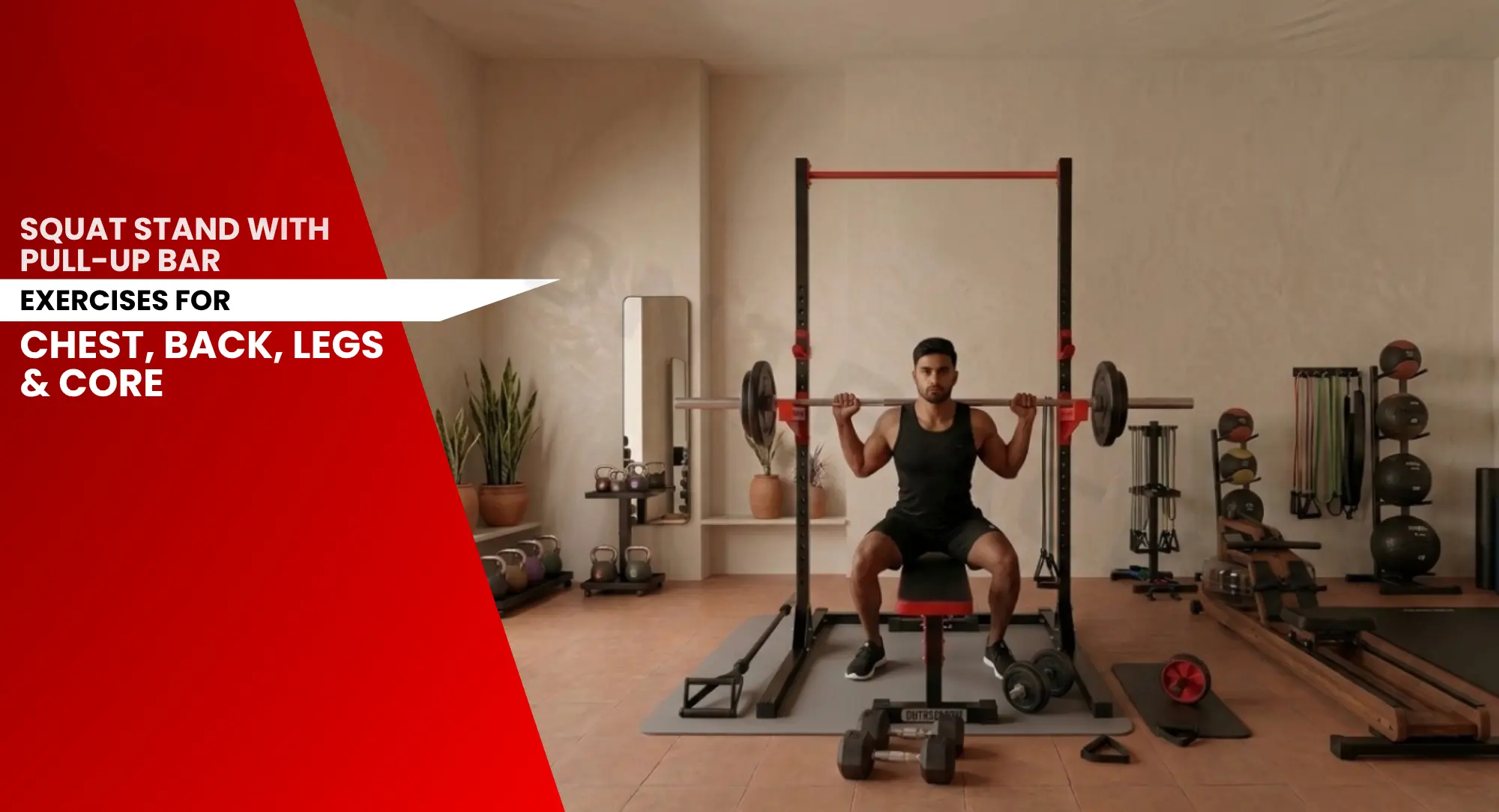
A squat stand with pull-up bar is one of the most space-efficient investments a gym can make. In a footprint smaller than a single cable machine, it supports barbell squats, bench press, pull-ups, hanging core work, and a dozen other exercises that collectively cover every major muscle group in the body.
For gym owners managing tight floor plans and for commercial facilities where every square metre needs to earn its space that kind of versatility matters. This guide covers 12 exercises across five muscle groups, with step-by-step form instructions, sets and reps, and common mistakes for each. There is also a practical buying guide at the end for gym owners evaluating squat stand setups in India.
A squat stand is a freestanding strength frame with adjustable barbell hooks (J-hooks) and safety spotter arms. When equipped with a pull-up bar attachment either integrated into the uprights or mounted overhead it becomes a dual-function station supporting both barbell-loaded and bodyweight exercises.
Unlike a full power rack, a squat stand has an open design with two uprights rather than a fully enclosed cage. This makes it more compact and easier to work around, at the cost of some maximum load capacity. For most commercial and personal training applications, a quality squat stand handles everything from beginner barbell work through to advanced compound lifts.
Primary muscles: Quadriceps, glutes
Secondary muscles: Hamstrings, erector spinae, core
How to do it
Set the J-hooks to just below shoulder height. Step under the bar and position it across your upper traps not on the base of your neck. Grip the bar slightly wider than shoulder-width. Unrack by standing tall, step back two steps, and set your feet hip to shoulder-width apart with toes turned out 15 – 30 degrees.
Brace your core hard, take a breath into your belly, then push your hips back and bend your knees simultaneously. Descend until your thighs are at least parallel to the floor, keeping your chest up and knees tracking over your toes. Drive through your heels to return to standing, then exhale at the top.
Sets and reps: 3–5 sets of 3–8 reps for strength; 3–4 sets of 8–12 for hypertrophy
Suggested weight: Begin conservatively with just the barbell to learn the pattern
Primary muscles: Quadriceps, core Secondary muscles: Upper back, glutes, hip flexors
How to do it
Set the bar at the same height as for a back squat. Step under it and position it across the front of your shoulders, your fingertips rest lightly on the bar with elbows pushed forward and up, creating a shelf from your shoulders. The bar should feel supported by your shoulder muscles, not held up by your wrists.
Unrack and step back. Set your feet as you would for a back squat. Keep your elbows high throughout the movement, if they drop, the bar will roll forward. Descend with a more upright torso than a back squat demands, squatting between your legs rather than sitting back. Drive up through your heels and maintain elbow height to the top.
Sets and reps: 3–4 sets of 5–8 reps Suggested weight: 15–20% lighter than your back squat to start
Primary muscles: Glutes, quadriceps
Secondary muscles: Hamstrings, hip stabilisers, core
How to do it
Set the J-hook or a nearby bench at roughly knee height. Stand about two feet in front of the stand, and place your rear foot on the bar or bench behind you the top of your foot faces down. Your front foot should be far enough forward that your shin stays vertical when you descend.
Holding dumbbells at your sides or a barbell across your traps, bend both knees simultaneously and lower your rear knee toward the floor. The front knee should track over your front toes. Drive through your front heel to return to standing. Complete all reps on one side before switching.
Sets and reps: 3 sets of 8–10 reps per leg Suggested weight: Bodyweight first; add load only when the balance and movement pattern are solid
Primary muscles: Pectorals (chest) Secondary muscles: Triceps, anterior deltoids
How to do it
Position an adjustable bench flat under the squat stand. Set the J-hooks so you can unrack the bar with arms almost fully extended not so high that you have to press up to unrack, and not so low you struggle to rerack safely. Lie on the bench with your eyes directly under the bar.
Grip the bar slightly wider than shoulder-width. Plant your feet flat on the floor, create a slight arch in your lower back, and pull your shoulder blades together and down into the bench. Unrack, lower the bar to your mid-chest with your elbows at roughly 45–75 degrees from your torso, then press back to full extension. Do not bounce the bar off your chest.
Sets and reps: 3–5 sets of 5–8 reps for strength; 3–4 sets of 8–12 for muscle development Suggested weight: Start light to establish bar path before adding load
Primary muscles: Upper chest (clavicular head of pectoralis major), anterior deltoids Secondary muscles: Triceps, core stabilisers
How to do it
Set your adjustable bench to a 30–45 degree incline under the squat stand. Readjust the J-hooks higher to match the incline position. Grip the bar slightly wider than shoulder-width. The set-up and execution mirror the flat bench press, with the bar lowering to your upper chest just below the collarbone rather than the mid-chest.
Sets and reps: 3 sets of 8–12 reps Suggested weight: Typically 10–15% lighter than your flat bench press
Primary muscles: Chest, anterior deltoids Secondary muscles: Core, triceps
How to do it
Set one of the J-hooks or spotter arms at a fixed height somewhere between knee and waist level. Place your hands on the bar, slightly wider than shoulder-width, and walk your feet back into a plank position. Your body should form a straight line from head to heels. Lower your chest toward the bar, keeping your elbows at a 45-degree angle from your body, then push back to the start.
Sets and reps: 3 sets of 12–20 reps, or to failure with good form Suggested weight: Bodyweight. Elevating the hands reduces intensity lower the bar to increase difficulty.
Primary muscles: Latissimus dorsi (lats), upper back Secondary muscles: Biceps, forearms, rear deltoids
How to do it
Grip the pull-up bar slightly wider than shoulder-width, palms facing away. Hang with arms fully extended. Pull your shoulder blades down and back before initiating the movement this protects the shoulder joint and ensures the lats do the work. Drive your elbows toward your hips as you pull your chin up toward or over the bar. Lower yourself under control to a full hang.
Sets and reps: 3–4 sets to 1–2 reps short of failure, or 3 sets of 5–10 for intermediate lifters Progression: Band-assisted pull-ups for beginners; weighted pull-ups with a belt for advanced
Primary muscles: Biceps, lats Secondary muscles: Forearms, rear deltoids, core
How to do it
Grip the pull-up bar at shoulder-width or slightly narrower, palms facing toward you. Execution is the same as a pull-up hang fully extended, engage the shoulder blades, and pull your chin up and over the bar. Lower under control.
Sets and reps: 3–4 sets of 5–12 reps Difference from pull-up: The underhand grip recruits the biceps more heavily and allows most people to move significantly more weight, making chin-ups an effective bridge exercise for clients working toward pull-up proficiency.
Primary muscles: Mid-back, rhomboids, rear deltoids Secondary muscles: Core, biceps, forearms
How to do it
Set the bar in the J-hooks at hip to waist height. Lie on your back underneath the bar with your chest directly below it. Grip the bar slightly wider than shoulder-width, palms facing away. Extend your legs and plant your heels on the floor, your body should be in a straight diagonal line from heels to shoulders. Pull your chest up to the bar, squeezing your shoulder blades together at the top, then lower under control.
Sets and reps: 3 sets of 10–15 reps Difficulty adjustment: Straightening the legs and raising the feet increases difficulty. Bending the knees and keeping feet flat reduces it.
Primary muscles: Lower abs, hip flexors Secondary muscles: Core stabilisers, forearms (grip)
How to do it
Hang from the pull-up bar with a shoulder-width overhand grip. Brace your core and allow a slight posterior pelvic tilt, tuck your pelvis slightly under rather than letting your lower back arch. Bend both knees and pull them upward toward your chest in a controlled arc. Pause briefly at the top, then lower your legs with control. Avoid swinging or using momentum.
Sets and reps: 3 sets of 10–20 reps
11. Hanging Leg Raise
Primary muscles: Lower abs, rectus abdominis, hip flexors Secondary muscles: Core stabilisers, grip
How to do it
Hang from the pull-up bar with the same grip as the knee raise. With legs straight (or near-straight with a slight bend at the knees), brace your core and raise both legs together until they are parallel to the floor or higher if your strength and mobility allow. Lower them under control to the starting position without swinging.
Sets and reps: 3 sets of 8–15 reps
Primary muscles: Full core (rectus abdominis, obliques, hip flexors) Secondary muscles: Lats, grip, shoulders
How to do it
Hang from the pull-up bar with a shoulder-width grip. Engage the lats think about pulling the bar apart with your hands and begin the movement by engaging your core, not swinging. Drive your toes upward toward the bar in a controlled arc, keeping your legs as straight as possible. Touch or approach the bar with your toes at the top, then lower with control.
Sets and reps: 3 sets of 5–10 reps. Quality over quantity half-controlled reps are not worth doing.
Not all squat stands are built to the same standard. For commercial gym use where the equipment is loaded by multiple users daily these factors are non-negotiable.
Frame material and construction. Commercial-grade squat stands are built from heavy-gauge steel tubing, typically 60 × 60 mm or larger. Thinner tubing may handle individual home use but will flex and fatigue under the repeated loading of a commercial environment. Check the stated load capacity and ensure it accounts for dynamic loading (Olympic lifts and plyometric movements), not just static weight.
Pull-up bar quality and grip options. The pull-up bar should be welded or bolted with zero flex at the connection point. Multi-grip options standard overhand, close grip, and neutral grip increase exercise variety. Knurled or textured coating on the bar prevents slipping under heavy use.
J-hook adjustment range. Hooks that adjust in small increments (every 50–75 mm) accommodate a wider range of user heights and exercise types. Hooks with a protective cover or liner prevent barbell damage and reduce noise.
Base stability. The base width directly determines how much the stand wobbles under load. Wider bases are more stable but consume more floor space. For commercial settings, choose a base with bolt-down capacity so the stand can be anchored to the floor if needed.
Expansion compatibility. Quality squat stands accept optional attachments: band pegs, dip bars, landmine units, plate storage horns, and safety arm extensions. These additions extend the station’s exercise range and long-term value without replacing the core frame.
Weight capacity. Commercial squat stands should have a minimum rated capacity of 200–250 kg. Anything lower is designed for home use only and will degrade quickly under commercial conditions.
A squat stand with pull-up bar is most effective as part of a planned strength zone. The core additions that maximise its value:
An Olympic barbell and a full set of weight plates are essential. Without them, you can only use the pull-up bar and frame-based exercises. A rubber-coated plate set protects your flooring and reduces impact noise during loading and unloading.
An adjustable bench ideally one that inclines to at least 45 degrees unlocks all the pressing exercises. Without it, the squat stand cannot support chest training at all.
Rubber flooring under and around the station protects the floor from dropped plates and significantly reduces the noise profile of the station in open-plan gym layouts.
Resistance bands add value for assisted pull-up progressions and warm-up exercises around the station.
Frequently Asked Questions
Yes. Beginners can safely use squat stands for exercises like elevated push-ups, inverted rows, chin-ups, and hanging knee raises. Barbell exercises should be performed with proper guidance and lighter weights initially.
A squat stand has an open, compact design that saves floor space and supports functional training. A power rack provides a fully enclosed lifting area and is better suited for heavy strength training and powerlifting.
Most commercial squat stands support between 200 kg and 500 kg depending on frame quality and construction. Always check manufacturer load capacity before use.
Yes. The pull-up bar supports pull-ups, chin-ups, hanging leg raises, and bodyweight exercises. It can still function as a complete bodyweight training station.
Rubber flooring is highly recommended for squat stand areas because it improves floor protection, reduces noise, and enhances workout safety.
Absolutely. Squat stands are compact, versatile, and cost-effective, making them ideal for school gyms, college fitness centers, and sports training facilities in India.
At OnTrackYou, we manufacture heavy-duty commercial squat stands and complete strength-zone equipment for gyms, fitness studios, sports academies, schools, hotels, and corporate wellness facilities across India.
Our squat stand setups are built for the demands of full commercial use high load ratings, adjustable heights to accommodate all users, durable surface finishes, and expansion compatibility for attachments that grow with your facility.
We also supply everything needed to complete your strength zone: Olympic barbells, weight plates, adjustable benches, rubber flooring, dumbbell racks, and functional training equipment with complete gym setup consultation included.
Planning a commercial gym setup or upgrading your existing strength area?
Contact OnTrackYou for squat stands, strength equipment, and complete commercial gym solutions across India.

Copyright © 2026 OnTrackYou | Powered by Kinetic Dreamers
