

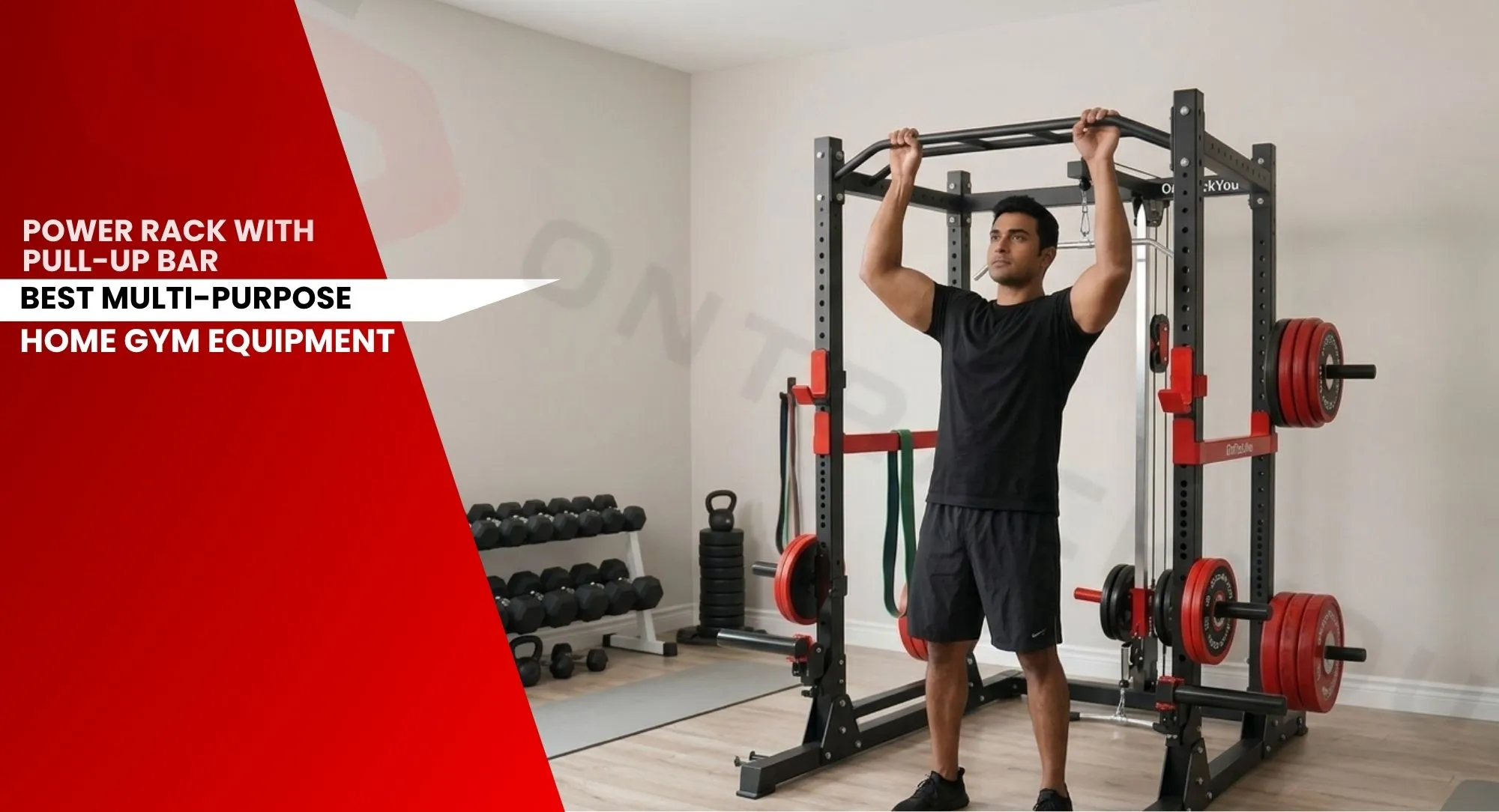
If you are building a serious home gym in India and want one piece of equipment that replaces a squat rack, cable crossover tower, LAT pulldown machine, pull-up station, and dip bar without requiring five separate machines and the floor space to match the power rack with cable crossover and LAT pulldown is the answer.
OnTrackYou’s multi-functional power rack combines a heavy-duty four-upright safety cage, a dual-pulley cable crossover system, an integrated LAT pulldown and low row station, a multi-grip pull-up bar, dip handles, adjustable J-hooks, safety spotter arms, and plate storage pegs in a single compact frame. The result is a power rack that supports over 40 exercises across every major muscle group making it the most versatile all-in-one home gym equipment available for both home gym setups and commercial strength zones across India.
A basic power rack supports barbell exercises only squats, bench press, overhead press. OnTrackYou’s power rack goes significantly further by integrating three training systems into one frame:
The power cage: a four-upright enclosed safety cage with adjustable J-hooks and spotter arms. The enclosed design means you can train alone without a spotter. If you fail a heavy squat or bench press, the spotter arms catch the bar safely. This is the core of the machine and the reason a power rack is safer than a squat stand for solo home gym training.
The cable crossover system: dual adjustable cable pulleys mounted to the frame, accepting standard cable attachments (rope, straight bar, D-handles, ankle straps). Cable exercises provide continuous tension through the full range of motion a training stimulus that free weights alone cannot replicate. Chest flyes, cable rows, tricep pushdowns, and cable curls are all possible from this system.
The LAT pulldown and low row station: a dedicated high and low pulley with a plate-loaded cable system at the rear of the rack. This is the same mechanism found in a standalone LAT pulldown machine. It supports LAT pulldowns, seated cable rows, overhead cable tricep extensions, and cable bicep curls.
Together, these three systems make this power rack a complete all-in-one home gym equipment solution one that eliminates the need for multiple machines and the floor space they demand.
1. Barbell Back Squat
Primary muscles: Quadriceps, glutes Secondary muscles: Hamstrings, erector spinae, core
How to do it
Set the J-hooks to just below shoulder height on the power rack uprights. Step under the barbell and position it across your upper traps not on the base of your neck. Grip the bar slightly wider than shoulder-width and unrack it by driving through your legs to stand tall. Step back two controlled steps and set your feet hip to shoulder-width apart, toes turned out 15–30 degrees.
Take a deep breath into your belly, brace your core hard, then push your hips back and bend your knees simultaneously. Descend until your thighs reach at least parallel to the floor, keeping your chest up and knees tracking over your toes. Drive through your heels to return to standing, then exhale at the top.
Before every session, set the spotter arms just below your lowest squat depth. If you fail a rep, lower the bar onto the spotters and step out safely no spotter needed.
Sets and reps: 3–5 sets of 3–8 reps for strength; 3–4 sets of 8–12 for muscle development Starting weight: Bar only until the movement pattern is consistent
Primary muscles: Quadriceps, core Secondary muscles: Upper back, glutes
How to do it
Set the J-hooks at the same height as for the back squat. Position the bar across the front of your shoulders with elbows pushed forward and up your fingertips rest lightly on the bar while the load sits on the shelf created by your shoulder muscles. Unrack and step back. Keep your elbows high throughout the entire movement; if they drop, the bar rolls forward. Squat with a more upright torso than the back squat, driving through your heels all the way back to standing.
Sets and reps: 3–4 sets of 5–8 reps Suggested weight: Start 15–20% lighter than your back squat
Primary muscles: Glutes, quadriceps Secondary muscles: Hamstrings, hip stabilisers
How to do it
Set the power rack’s spotter arms or use a nearby bench at knee height. Stand roughly 60–70 cm in front of the rack and place your rear foot on the spotter arm with the top of your foot facing down. Your front foot should be far enough forward that your shin stays near-vertical when you descend. Hold dumbbells at your sides or rest a barbell across your traps. Lower your rear knee toward the floor by bending both legs simultaneously. Drive through your front heel to return to standing. Complete all reps on one side before switching.
Sets and reps: 3 sets of 8–10 reps per leg Suggested weight: Bodyweight first; add load only when balance and form are solid
Primary muscles: Pectorals Secondary muscles: Triceps, anterior deltoids
How to do it
Position a flat bench inside the power rack, centred below the J-hooks. Set the hooks so you can unrack the bar with arms nearly fully extended. Lie on the bench with your eyes directly under the bar. Grip slightly wider than shoulder-width, plant feet flat on the floor, and pull your shoulder blades together and down into the bench. Create a slight natural arch in your lower back. Unrack and lower the bar to your mid-chest with elbows at 45–75 degrees from your torso not flared perpendicular. Press to full extension.
Set the spotter arms at just below chest height before every session this allows you to safely lower the bar onto them if you fail a rep while training alone.
Sets and reps: 3–5 sets of 5–8 reps for strength; 3–4 sets of 8–12 for hypertrophy
Primary muscles: Upper chest, anterior deltoids Secondary muscles: Triceps
How to do it
Set your adjustable bench to 30–45 degrees inside the power rack and raise the J-hooks to match the incline height. Execution mirrors the flat bench press bar lowers to your upper chest just below the collarbone rather than the mid-chest. Maintain the same elbow angle and shoulder blade position.
Sets and reps: 3 sets of 8–12 reps Suggested weight: 10–15% lighter than your flat bench press
Primary muscles: Pectorals (inner and mid chest) Secondary muscles: Anterior deltoids, biceps
How to do it
Set both cable pulleys to the high position on the power rack’s crossover system. Attach D-handles. Stand in the centre of the rack, one foot slightly forward for balance. With arms nearly straight and a slight bend at the elbow, bring both handles down and together in a wide arc in front of your chest as if hugging a large tree. Squeeze the chest hard at the point where the handles meet. Slowly return to the starting position against the resistance.
Sets and reps: 3 sets of 12–15 reps Suggested weight: Light, this is an isolation movement. Focus on the squeeze, not the load.
Primary muscles: Latissimus dorsi (lats), upper back Secondary muscles: Biceps, rear deltoids
How to do it
Attach the wide LAT bar to the high pulley on the power rack’s LAT pulldown station. Sit on the seat or kneel in front of the station and secure your knees under the leg roller pads. Grip the bar wider than shoulder-width with an overhand grip. Pull your shoulder blades down and back before pulling the bar, this ensures the lats drive the movement rather than the biceps. Pull the bar to your upper chest, pause briefly, then return under full control.
Sets and reps: 3–4 sets of 8–12 reps
Primary muscles: Mid-back, rhomboids, rear deltoids Secondary muscles: Biceps, forearms, core
How to do it
Attach a close-grip V-bar or rope to the low pulley on the power rack. Sit on the floor or a low bench facing the pulley with feet braced against the footplate. Sit tall with your back straight. Pull the handle toward your lower abdomen, driving your elbows behind your body and squeezing your shoulder blades together at the full contraction. Return the handle forward with control, allowing your shoulder blades to stretch forward before the next rep.
Sets and reps: 3–4 sets of 10–12 reps
Primary muscles: Latissimus dorsi, upper back Secondary muscles: Biceps, forearms
How to do it
Grip the power rack’s multi-grip pull-up bar slightly wider than shoulder-width with an overhand grip. Hang with arms fully extended. Draw your shoulder blades down and back before pulling, this protects the shoulder joint and ensures the lats do the work. Drive your elbows toward your hips as you pull your chin up to or over the bar. Lower under full control to a dead hang.
Sets and reps: 3–4 sets to 1–2 reps short of failure; or 3 sets of 5–10 for intermediate lifters Progressions: Band-assisted for beginners; add a weight plate via a dipping belt for advanced
Primary muscles: Biceps, lats Secondary muscles: Forearms, rear deltoids
How to do it
Grip the bar at shoulder-width or slightly narrower with palms facing toward you. Execution is the same as the pull-up. The underhand grip increases bicep contribution and is mechanically easier — making chin-ups the best starting point for anyone building toward pull-up proficiency.
Sets and reps: 3–4 sets of 6–12 reps
Primary muscles: Anterior and medial deltoids, triceps Secondary muscles: Upper chest, core stabilisers
How to do it
Set the J-hooks at upper-chest height on the power rack. Grip the bar just outside shoulder-width. Unrack and step back. Brace your core and squeeze your glutes. Press the bar directly overhead — tuck your head back as the bar passes your face, then push your head through once it clears. Lock out with biceps near your ears. Lower to your upper chest under control.
Sets and reps: 3–4 sets of 5–8 reps for strength; 3 sets of 8–12 for shoulder development
Primary muscles: Medial deltoids (side shoulder) Secondary muscles: Anterior deltoids, trapezius
How to do it
Set one cable pulley to the low position on the power rack’s crossover system. Attach a D-handle. Stand sideways to the pulley with the cable crossing in front of your body. Grip the handle with your far hand. With a slight bend at the elbow, raise your arm out to the side until it reaches shoulder height no higher. Lower slowly and with control. Complete all reps on one side then switch.
Sets and reps: 3 sets of 12–15 reps per side Suggested weight: Very light, the side deltoid is a small muscle. Ego-driven weight here builds no muscle and risks the rotator cuff.
Primary muscles: Lower abs, hip flexors Secondary muscles: Core stabilisers, grip
How to do it
Hang from the power rack’s pull-up bar with a shoulder-width overhand grip. Apply a slight posterior pelvic tilt tuck the pelvis under to engage the abs before moving. Pull both knees upward toward your chest in a controlled arc. Pause briefly at the top, then lower under control. Your torso should remain nearly still throughout eliminate all swinging.
Sets and reps: 3 sets of 12–20 reps
Primary muscles: Lower abs, rectus abdominis Secondary muscles: Hip flexors, grip
How to do it
Hang from the pull-up bar as above. With legs straight or near-straight, brace your core and raise both legs together until they reach parallel to the floor or higher. Lower them under control without swinging. Apply the same posterior pelvic tilt cue tuck the pelvis before each rep to maximise abdominal engagement over hip flexor dominance.
Sets and reps: 3 sets of 8–15 reps
Primary muscles: Triceps Secondary muscles: Core stabilisers
How to do it
Attach a rope or straight bar to the high pulley of the power rack’s cable system. Stand facing the pulley with feet hip-width apart and a slight lean forward at the hips. Grip the attachment with both hands, elbows pinned close to your sides at roughly 90 degrees. Press the attachment downward until your arms are fully extended, squeezing the triceps at the bottom. Slowly return to the start do not let the elbows flare or rise above the starting position.
Sets and reps: 3 sets of 12–15 reps
Ceiling Height – Check This Before Everything Else
This is the most common oversight in Indian home gym purchases, and the one most likely to cause regret after delivery.
Most full-size power racks are quite tall taller than you might expect when browsing online. You need enough overhead clearance above the pull-up bar for your arms and head during pull-ups. Before purchasing anything, stand in the exact spot where your rack will go and measure the ceiling height at that point. Account for any ceiling fans, false ceilings, light fixtures, or beams directly above these reduce your usable clearance significantly.
Most newer Indian apartments have generously high ceilings and will accommodate a standard power rack without issue. Older construction, smaller rooms, and spaces with false ceilings are where problems most commonly arise. If you are unsure, contact the manufacturer with your ceiling measurement before placing your order any reputable supplier will tell you honestly whether their rack fits your space.
Frame Steel and Load Capacity
Not all power racks are built from the same quality of steel, and the difference is visible and felt once the rack is assembled. A rack built from thicker, heavier steel tubing will feel rock-solid under heavy loads with zero flex or wobble. Thinner steel may feel fine at lighter weights but will develop a noticeable wobble as your training progresses which is both distracting and a safety concern.
For most home gym users, a mid-range commercial-grade rack handles everyday strength training comfortably. If you are an experienced lifter or plan to train very heavy in the future, invest in a rack with a higher load rating, it is far more economical to buy the right rack once than to replace a lighter one after outgrowing it.
If you live in a coastal city or an area with high humidity particularly relevant during India’s monsoon season choose a rack with a powder-coated finish rather than a basic painted one. Powder coating resists rust and chipping significantly better under humid conditions and will keep your rack looking and performing well for far longer.
Cable System Quality
The cable crossover and LAT pulldown system is what makes this power rack genuinely different from a basic cage, so it deserves as much scrutiny as the frame when you are evaluating your purchase.
The key thing to check is how smoothly the pulleys run. A good pulley should feel buttery-smooth throughout the full range of movement with no catching, grinding, or resistance variation. Rough or sticky pulleys are a sign of lower-quality construction and will degrade further with use, making cable exercises frustrating rather than enjoyable.
The LAT pulldown seat or knee roller should feel completely stable during a heavy set no shifting, no wobbling. If it moves around during use, it will both affect the quality of your training and wear down the mounting hardware over time. Ask to see a demonstration or watch a video review of the specific model before purchasing.
J-Hook Adjustment Range
J-hooks are the barbell holders on the uprights, and the ability to adjust them precisely to your height makes a meaningful difference to both comfort and safety.
Hooks that adjust in small increments give you the freedom to set the bar at exactly the right height for your body neither too high nor too low for a safe unrack. Wider spacing between adjustment holes forces you to compromise your starting position, which is a particular issue for shorter or taller users.
Also check whether the hooks have a protective lining on the contact surface where the bar sits. This lining usually a firm plastic or nylon insert prevents metal-on-metal contact between the hook and your barbell. Without it, both the hook and the barbell knurling will wear against each other over time, degrading both. It is a small detail that adds up meaningfully over years of daily use.
Safety Spotter Arms – Non-Negotiable for Home Training
Spotter arms are the horizontal bars that sit below your barbell to catch it if you fail a lift. They are the single feature that makes a power rack genuinely safe for training alone and the reason a power rack is a better choice than a basic squat stand for home gym use.
Good spotter arms extend far enough inward to catch the bar reliably across its full path of movement. They should feel solid and immovable once set there should be no flex or rattle when loaded.
The most important habit to build from your very first session is setting the spotter arms before every single lift. For squats, they sit just below your lowest point in the squat. For bench press, just below your chest. This takes less than a minute and eliminates the most serious injury risk in heavy home gym training a failed lift with no one there to help. Never skip this step, regardless of how confident you feel about the weight.
Floor Space Planning for Indian Homes
A power rack takes up more floor space than most people anticipate when ordering online. The frame itself has a defined footprint, but around it you need working space room to load plates onto the barbell on both sides, space to step in and out of the rack, and room for a bench if you are pressing.
As a practical rule: if you cannot comfortably walk around all four sides of the rack with your arms slightly out, the space is too tight for safe use. A 10 × 10 foot dedicated room is a comfortable minimum for a full power rack setup in an Indian home. A large garage bay or a cleared corner of a spacious room also works well.
Rubber gym flooring underneath the entire rack area is strongly recommended. It protects your floor from dropped plates, prevents the rack feet from shifting on smooth surfaces, and significantly reduces the noise of loading and unloading a meaningful consideration in apartment buildings.
Frequently Asked Questions
What is a power rack with cable crossover and LAT pulldown?
It is a multi-functional strength-training setup that combines a power rack, cable crossover system, LAT pulldown station, pull-up bar, and low-row machine within one compact frame.
Is a power rack suitable for home gym use in India?
Yes. Power racks are ideal for Indian home gyms because they support full-body workouts, improve safety during solo training, and save space compared to multiple separate machines.
How is a power rack different from a squat stand?
A power rack has a four-post enclosed safety cage with spotter arms, while a squat stand has a more open two-post design with fewer safety features.
What is the difference between a power rack and a power cage?
There is no major difference. Both terms are commonly used for the same four-post strength-training rack system.
How much ceiling height is needed for a power rack?
Most standard power racks require around 260–270 cm ceiling height for comfortable pull-up movement and workout clearance.
Can a power rack replace a cable crossover machine?
Yes. A multi-functional power rack with dual pulleys can support cable flyes, rows, tricep pushdowns, curls, lateral raises, and many other cable exercises.
What accessories work with a power rack?
Most power racks are compatible with:
Build Your Gym Around a Power Rack That Does It All
The multi-functional power rack is the most efficient piece of strength equipment available for Indian home gyms and compact commercial strength zones. It consolidates five machines into one frame, trains every major muscle group, and provides the built-in safety infrastructure that makes heavy solo training possible.
At OnTrackYou, we manufacture and supply heavy-duty power racks with cable crossover and LAT pulldown systems for home gyms, commercial fitness centres, sports academies, hotels, schools, and corporate wellness facilities across India. Every rack is built to commercial-grade steel specifications, powder-coated for India’s climate, and designed for years of daily high-load use.
We also supply the complete equipment ecosystem around the rack Olympic barbells, rubber-coated weight plates, adjustable benches, rubber gym flooring, and cable attachment sets alongside full gym setup consultation so your space is planned efficiently before a single bolt is tightened.
Ready to build the most versatile home gym possible? Contact OnTrackYou for power racks, multi-functional gym equipment, and complete gym setup solutions across India.



Copyright © 2026 OnTrackYou | Powered by Kinetic Dreamers
