

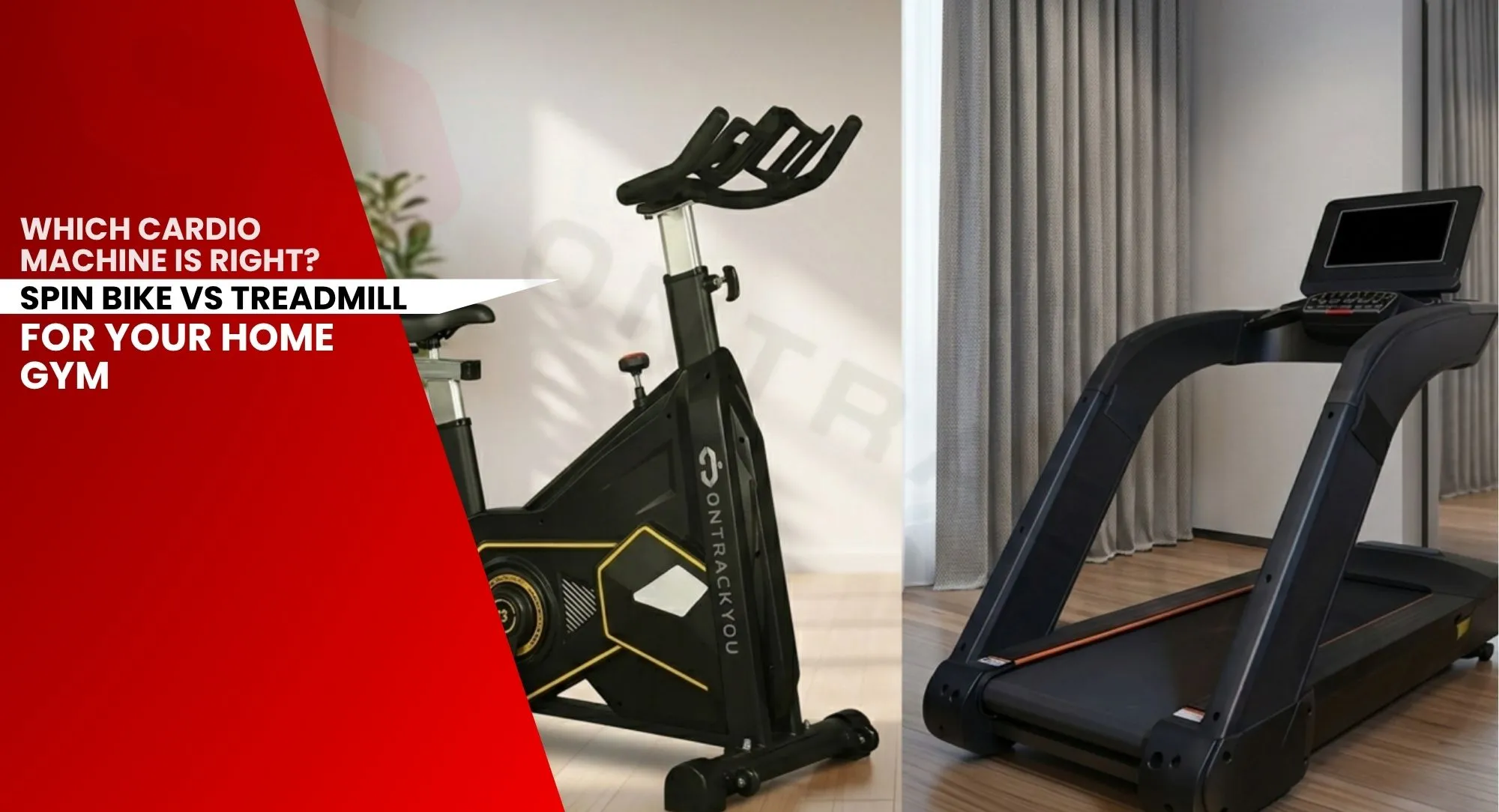
Almost every “spin bike vs treadmill” article online answers the question the same way: treadmills burn slightly more calories, bikes are easier on the joints, pick whichever you’ll actually use. That answer is not wrong, but it is incomplete for an Indian home gym buyer, because it skips the three factors that matter most once the machine is actually sitting in your flat noise that travels through shared walls, floor space measured in square feet rather than square metres, and an electricity and maintenance reality that differs meaningfully from a detached Western house with a garage.
This guide answers the question properly for that context covering the fitness factors everyone discusses, and the practical Indian home factors most articles never mention.
If your home gym sits in an apartment, shares walls with neighbours, or has a footprint under 80 square feet, a spin bike is almost always the more sensible choice. It is quieter, more compact, has no motor to maintain, and delivers an equally effective cardio workout.
If you have a dedicated room or garage space, want to train for running events, or specifically need full-body weight-bearing cardio, a treadmill is worth the extra space, cost, and maintenance it demands.
The rest of this guide explains exactly why and gives you a clear way to decide for your specific situation.
A treadmill uses a motorised belt to simulate walking, jogging, or running in place. Because you bear your own bodyweight with every step, your muscles, bones, and joints all experience load throughout the movement which is part of what makes it effective, and part of what makes it demanding on the body.
A spin bike uses a weighted flywheel with adjustable resistance to simulate cycling. Your bodyweight is supported by the seat throughout, so the joints carry significantly less impact. The workout intensity comes from how hard you pedal against the resistance, not from your bodyweight striking a surface repeatedly.
This single mechanical difference weight-bearing versus weight-supported is the root of almost every other difference between the two machines.
Treadmills generally produce a higher calorie burn per minute at matched perceived effort, largely because running and incline walking engage the core, arms, and upper body in addition to the legs your whole body is working to move you forward and keep you upright.
Spin bikes burn calories primarily through the legs and core. At a casual pace the difference is noticeable. At high intensity standing climbs, sprint intervals, heavy resistance a hard spin session can match or exceed a treadmill session in total calories burned, simply because you can sustain a harder effort for longer when your joints aren’t absorbing repeated impact.
In practice, the calorie-burn gap between the two machines closes significantly once you compare a genuinely hard session on each, rather than a leisurely one.
This is where the two machines diverge the most, and where most buyers should weight their decision heavily.
Treadmill use, even at a walking pace, places repeated impact through the ankles, knees, and hips with every step. For most healthy adults this is manageable and even beneficial for bone density. For anyone managing knee or hip discomfort, recovering from a joint-related injury, carrying significant extra body weight, or simply older and wanting to protect their joints long-term, that repeated impact adds up over months and years of regular use.
A spin bike removes almost all of that impact. The seat supports your bodyweight throughout, so the legs work hard without the knees and hips absorbing shock. This is precisely why spin bikes are widely recommended for joint-friendly cardio, and why many physiotherapists suggest cycling as a safer alternative during the early stages of returning to exercise after a lower-body injury.
If joint health is a genuine concern for you or anyone in your household who will use the machine, this single factor often settles the decision on its own.
This matters enormously in Indian homes and gets almost no attention in most comparison articles, most of which are written for buyers with detached houses and basements.
A treadmill motor, belt, and the repeated footfall of running produce continuous noise and a degree of vibration that travels through floors a real concern in apartment buildings, especially if your home gym sits above someone else’s living space or bedroom. Early morning or late evening sessions, when many people in India actually train around work hours, are when this becomes most noticeable to neighbours.
A belt-driven spin bike, by contrast, is close to silent. There is no footfall, no motor noise beyond a faint whir, and the resistance mechanism itself produces almost no sound. For anyone training in a flat, training at odd hours, or simply wanting to avoid becoming “that neighbour,” this is a genuinely significant practical advantage that rarely gets weighed properly in generic articles.
Most home gym articles discuss floor space in square metres aimed at Western house sizes. In Indian flats, the more useful comparison is simpler: a spin bike occupies roughly the footprint of a single chair when not in use, and most models include transport wheels so they can be rolled into a corner between sessions.
A treadmill, even a foldable one, needs a dedicated rectangular footprint for the full belt length plus clearance at both ends for safe entry and exit while moving. In a typical Indian bedroom or balcony being repurposed as a home gym corner, this is frequently the difference between a machine that fits comfortably and one that dominates the room.
If your home gym space is genuinely tight a corner of a bedroom, a small balcony, a compact second room a spin bike is very often the only realistic option of the two.
Spin bikes are mechanically simpler than treadmills a flywheel, a resistance mechanism, a seat, and a frame, with no motor and no belt to maintain. This translates to lower upfront cost, fewer parts that wear out, and minimal ongoing maintenance beyond occasional bolt checks and cleaning.
Treadmills have a motor, a moving belt, and a deck that absorbs repeated impact all of which require periodic maintenance and eventually wear out. Over several years of regular use, treadmill ownership typically involves higher maintenance costs and a greater chance of needing a repair or part replacement than a spin bike does.
For a buyer prioritising long-term value and minimal upkeep, a spin bike is generally the lower-maintenance investment of the two.
None of this means a treadmill is the wrong choice, it simply suits a different situation and goal.
If you are training specifically for running events, want incline-based training that closely mimics outdoor terrain, or want a cardio machine that meaningfully engages your upper body and core alongside your legs, a treadmill delivers something a spin bike fundamentally cannot replicate. Walking and running are also more intuitive movements for many beginners who find pedalling cadence and resistance settings less immediately natural.
If your home has a dedicated gym room, garage, or large balcony with no noise-sensitive neighbours below or beside it, the space and noise concerns that favour a spin bike for apartment living simply don’t apply to you in the same way.
Ask yourself these three questions in order. The first one you answer decisively will usually settle the choice.
Do you or anyone in your household have joint pain, an old injury, or a condition where high-impact exercise is a concern? If yes, choose a spin bike.
Does your home gym space sit in an apartment with neighbours below, beside, or sharing walls? If yes, lean strongly toward a spin bike unless you can guarantee training only during hours when noise is not a concern.
Do you have a genuinely dedicated room or garage, no major joint concerns, and a specific goal tied to running or full-body weight-bearing cardio? If yes, a treadmill is a sound investment.
Most Indian home gym buyers training in a flat, with some space constraint, and a general fitness or weight-loss goal rather than a running-specific one will find the spin bike is the more practical, lower-maintenance, and genuinely sustainable choice.
Is a spin bike or treadmill better for weight loss? Both are effective for weight loss when used consistently. Treadmills typically burn slightly more calories per minute at a casual pace because they engage more of the body, but a high-intensity spin session can match or exceed that calorie burn. The machine that produces better long-term weight loss results is almost always the one you actually use consistently and for many people in apartment settings, that ends up being the spin bike simply because it is easier and quieter to use regularly.
Which is quieter for an apartment a spin bike or a treadmill? A belt-driven spin bike is significantly quieter than a treadmill. There is no motor noise and no repeated footfall vibration transferring through the floor, which makes it a far more practical choice for apartment living, especially for early morning or late evening sessions where noise could disturb neighbours.
Is a spin bike good for bad knees? Yes, generally. A spin bike supports your bodyweight on the seat throughout the workout, removing the repeated impact that running or walking on a treadmill places through the knees. Many physiotherapists recommend cycling specifically because it allows cardiovascular training with minimal joint stress, though anyone with an existing knee condition should still confirm with a doctor or physiotherapist before starting a new exercise routine.
How much space do I need for a spin bike compared to a treadmill? A spin bike occupies a footprint roughly the size of a chair and can typically be rolled into a corner between sessions thanks to built-in transport wheels. A treadmill needs a dedicated rectangular space for the full belt length plus safe clearance at both ends, making it a significantly larger commitment in a typical Indian flat or compact home gym corner.
Which requires less maintenance, a spin bike or a treadmill? A spin bike requires less maintenance. It has no motor and no moving belt just a flywheel, resistance mechanism, and frame, so upkeep is largely limited to occasional bolt tightening and cleaning. Treadmills have more moving parts, including a motor and belt that need periodic servicing and eventual replacement, which adds to long-term ownership cost.
At OnTrackYou, we manufacture both spin bikes and treadmills designed for Indian home gyms and commercial fitness spaces. Our Spin Bike Extreme features a 24 kg flywheel with adjustable resistance, a 200 kg user weight capacity, and a belt-driven mechanism that keeps noise to a minimum built specifically for the realities of home training in India. Our treadmill range spans home-use and semi-commercial options for those with the space and goals that call for one.
Whichever machine fits your space, budget, and fitness goals, we can help you choose the right one rather than the most heavily marketed one.
Not sure which cardio machine suits your home gym? Contact OnTrackYou for personalised guidance, spin bikes, treadmills, and complete home gym equipment across India.
OnTrackYou is a manufacturer and supplier of professional fitness equipment for home gyms and commercial fitness centres across India, headquartered in Vadodara, Gujarat.



Copyright © 2026 OnTrackYou | Powered by Kinetic Dreamers
